Reflect
Share what’s on your mind in your own words.
Compare Soma Pattern
Most self-reflection tools help you understand a thought, feeling or moment. Soma Pattern connects signals across conversations and time to reveal recurring beliefs, predictions, protective strategies, reactions and evidence of change.
Whether you’re trying to understand your own patterns or maintain continuity across client work, the difference is not more conversation. It’s seeing the architecture underneath it.
Compare Soma Pattern with AI journaling, ChatGPT, self-reflection apps and practitioner AI tools.
A different layer of intelligence
Journals capture what you write. Chatbots respond to what you ask. Regulation tools help in a moment. Session-note tools document what happened.
Soma is built around a different question:
“What keeps repeating across all of it?”
It connects experiences across time and organises them into an evolving pattern architecture — while keeping interpretations revisable as new evidence appears.
Share what’s on your mind in your own words.
Soma finds patterns across time, not just in the moment.
See how thoughts, feelings, behaviours and beliefs connect.
Track progress with real evidence, not just how you feel.
| Tool category | Usually helps with | What may remain difficult to see | Soma Pattern |
|---|---|---|---|
| Journaling | Reflection, writing, processing | Patterns distributed across many entries | Connects reflections into recurring patterns |
| AI chat | Questions, conversation, advice | A structured model of recurrence and change | Organises signals into an evolving pattern map |
| Regulation tools | Managing the current state | Why similar activation keeps returning | Links current states to deeper recurring patterns |
| Session-note tools | Documenting what happened | Longitudinal client understanding | Maintains an evolving view across sessions and time |
Search starts with a question
People and practitioners often begin with the thing they are trying to understand — not the name of a software category.
For personal reflection
Soma is designed for people who want to understand not only what they feel today, but how beliefs, reactions, decisions and protective strategies appear to connect across time.
| Capability | Traditional journal | AI journal | General AI chat | Soma Pattern |
|---|---|---|---|---|
| Reflect on a current experience | Yes | Yes | Yes | Yes |
| Recall previous material | Limited / manual | Often | Depends on context and memory | Yes |
| Identify recurring themes | Manual | Often | Can when asked | Yes |
| Build explicit pattern architecture | — | Varies | — | Yes |
| Map beliefs, predictions and protective strategies | — | Varies | Can discuss | Yes |
| Visual pattern map | — | Rare | — | Yes |
| Track supporting evidence | — | Varies | Unstructured | Yes |
| Track weakening / contradictory evidence | — | Rare | Unstructured | Yes |
| Show new responses forming | — | Varies | Unstructured | Yes |
| Current-state orientation | — | Sometimes | Conversational | Inner Weather |
| Decision-specific pattern analysis | — | Rare | Conversational | Decide Now |
| Personalised practices and experiments | Sometimes | Often | Yes | Pattern-linked |
| Longitudinal change view | Manual | Varies | Limited | Yes |
Soma does not simply remember that something was discussed before. It asks whether a signal recurs, what it appears connected to, what evidence supports it, what contradicts it, and whether a different response is beginning to appear.
A belief may appear in one conversation. A protective strategy may appear somewhere else. A decision weeks later may reveal the same prediction.
Soma Map brings those signals together so users can explore: beliefs → predictions → triggers → protective strategies → regulated alternatives → evidence → change.
See your current state, dominant patterns and where things are moving.
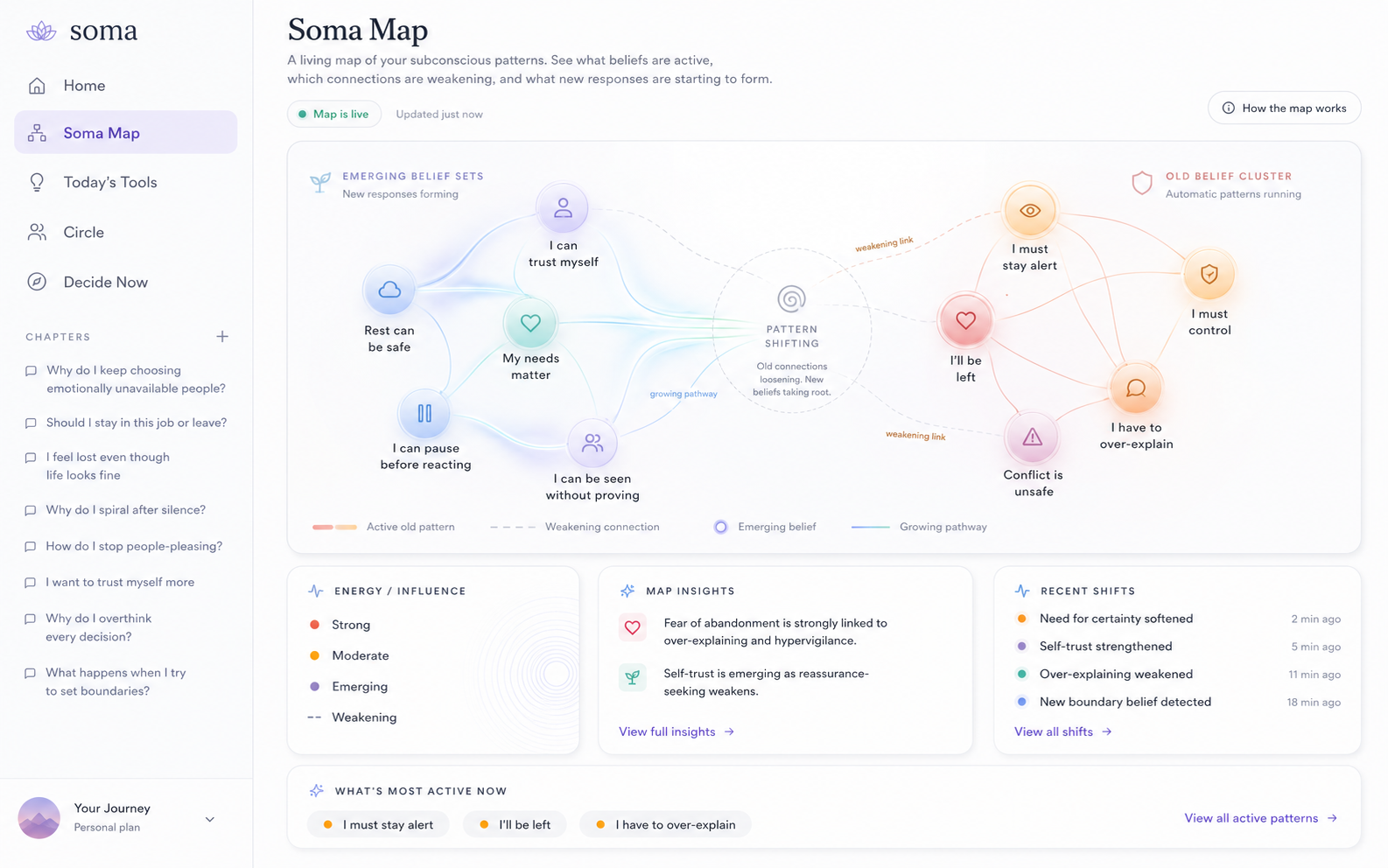
Visualise how beliefs, triggers, predictions and protective responses connect.
More than insight
Recognising a pattern can be useful. But knowing a pattern exists does not tell you whether it is loosening, strengthening or simply appearing in a different form. Soma is designed to keep looking.
The predicted pattern appeared again.
The old response occurred, but with less intensity or less automaticity.
Reality did not behave as the pattern predicted.
A different choice or regulation strategy became available.
For coaches, therapists & reflective practitioners
Notes tell you what happened. Transcripts preserve what was said. Soma Professional is designed to help practitioners maintain an evolving view of recurring client patterns, interventions, evidence of change, what remains stuck and what may deserve attention next.
| Capability | Notes / EHR | AI transcription | Generic AI assistant | Soma Professional |
|---|---|---|---|---|
| Store session information | Yes | Yes | Limited | Yes |
| Summarise a session | Manual / varies | Yes | Yes | Yes |
| Maintain continuity across sessions | Manual | Varies | Context-dependent | Yes |
| Surface recurring client patterns | Manual | Sometimes | When prompted | Yes |
| Separate beliefs, triggers and protective strategies | — | — | Conversational | Yes |
| Track interventions over time | Manual | — | — | Yes |
| Track what appears to help / remain stuck | Manual | — | Unstructured | Yes |
| Surface contradictory evidence | Manual | — | Unstructured | Yes |
| Next-session inquiry directions | Manual | Sometimes | Yes | Grounded in reviewed material |
| Evidence-of-change view | Manual | — | — | Yes |
| Progress report generation | Sometimes | Sometimes | Yes | Longitudinal |
| Separate practitioner Personal space | N/A | N/A | N/A | Yes |
A note is a record. Continuity intelligence asks what keeps returning, what changed, what worked, what remains stuck, where evidence is contradictory and what may deserve exploration next.
Sanitized demonstration views show how practitioner-provided material can be distilled into cautious, reviewable continuity intelligence.
See what is recurring, what may be shifting, and where Soma still needs more evidence.
Explore what she predicts will happen if someone is unhappy with her and she does not immediately explain, fix or reassure.
Why this mattersMay clarify whether reassurance-seeking is being driven by fear of rejection, responsibility for others’ emotions, or both.Ask how Maya knows when preparation is serving the task versus trying to remove uncertainty about how she will be judged.
Evidence to look forCompare a situation where preparation improved the outcome with one where it continued after the practical work was already complete.Explore what happens internally after Maya says no or leaves something unresolved.
Still unclearShe appears more able to hold the boundary behaviourally, but internal rumination may remain active afterwards.Possible inquiry directions derived from reviewed material — not instructions or diagnoses.
See what appears to be changing, what remains active, and what complicates the current interpretation.
Choosing the right tool depends on what you actually want to understand or accomplish.
Comparison categories
Detailed comparisons to help you understand which kind of tool fits your use case. Select a category to see how Soma compares.
The category
Longitudinal pattern mapping is the process of examining signals across multiple experiences and points in time to identify recurring relationships between beliefs, predictions, triggers, protective strategies, emotional responses and behaviour.
Soma Pattern applies this approach through an evolving system of observations, working hypotheses and evidence. Patterns can become more supported, remain uncertain, weaken or be contradicted as new information appears.
It is different from simply summarising previous conversations because the goal is not merely to remember what happened. The goal is to examine what appears to recur, how those elements may relate, and whether that structure is changing over time.
Something happens in your life.
Similar patterns appear again.
Soma identifies a possible pattern.
New data confirms, weakens or challenges it.
Conflicting evidence adds nuance.
The pattern map is updated.
A clearer understanding and new possibilities emerge.
Frequently asked questions
See what keeps repeating
Start with a conversation. Over time, Soma builds an evolving view of the patterns, evidence and new responses appearing across your life.
Working with clients? Explore Soma Professional